
The new guidelines for documenting falls are among the most significant updates in OASIS‑E2, effective April 1, 2026. The updates are designed to make fall reporting more complete, accurate, and consistent, helping clinicians keep patients safe and improving quality reporting.
CMS recognized that the Falls with Major Injury (FMI) quality measure was underreporting events when relying solely on OASIS data. To address this, CMS finalized the OASIS‑E2 fall documentation updates, clarifying definitions of falls, injury severity, and counting rules. This ensures that the information recorded in J1800 and J1900 is accurate and consistent, creating a reliable foundation for CMS as it implements future updates to the FMI measure in the Home Health Quality Reporting Program (QRP).
Here is an overview of the key changes in OASIS‑E2 for falls:
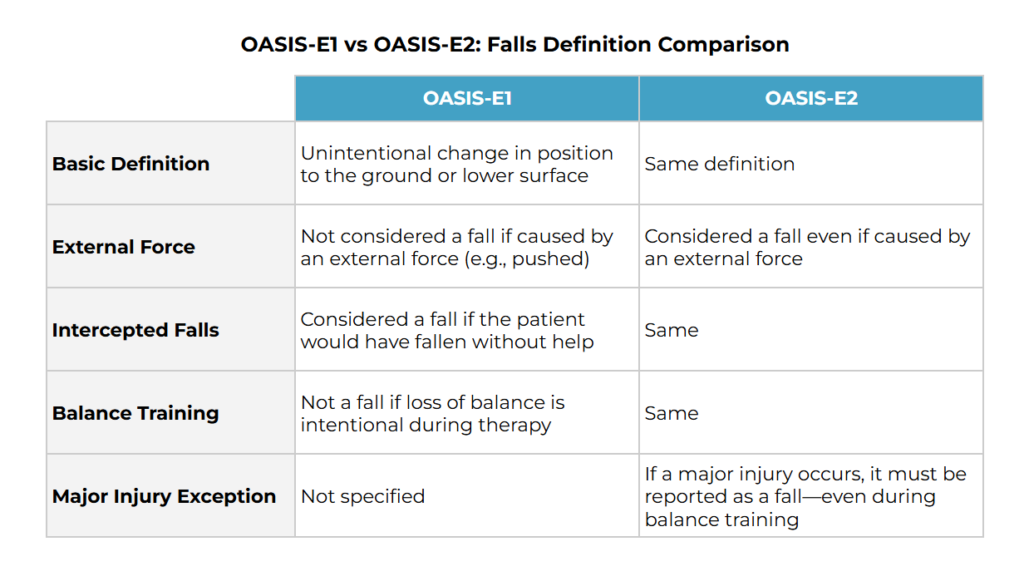
1. Broader Definition of a Fall
Under OASIS‑E2, any event where a patient loses balance and hits the ground counts as a fall — even if it occurred outside the home or was caused by an external force, such as tripping over an object or being bumped by someone. All falls since the last Start of Care (SOC) or Resumption of Care (ROC) must be recorded.
2. Clearer Injury Categories
Falls are now classified by severity:
- Major injuries: Includes, but is not limited to, traumatic bone fractures, joint dislocations/subluxations, internal organ injuries, amputations, spinal cord injuries, head injuries, and crush injuries.
- Non-major injuries: Includes, but is not limited to, skin tears, abrasions, lacerations, superficial bruises, hematomas, and sprains; or any fall-related injury that causes the patient to complain of pain.
3. How to Document Falls in OASIS‑E2
- J1800: indicate if any falls occurred.
- J1900: record the total number of falls since SOC/ROC and the highest level of injury for each.
- If the patient has multiple injuries in a single fall, record the fall at the highest level of injury.
- Use a dash (“–”) only if no information is available after asking the patient or caregiver.
- Fractures confirmed to be pathological (rather than traumatic) should NOT be considered a major injury resulting from a fall.
Remember that every fall should be documented, including the injury level, and recorded accurately. The updated rules make it easier to identify patterns, prevent future falls, and keep patients safe.
Ensuring Accuracy in Fall Documentation
As clinicians adjust to the new OASIS‑E2, leverage your QA team to review assessments and confirm that all falls are documented, totals in J1900 match clinical events, and injury severity is coded correctly. Beyond falls, QA should also ensure that all OASIS‑E2 updates are properly applied, helping clinicians as they adapt to the new requirements while maintaining agency compliance throughout the transition.
Why This Matters
By updating fall documentation in OASIS‑E2, CMS ensures that home health agencies capture all relevant falls accurately and classify injuries consistently. This not only enhances patient safety tracking but also provides reliable data for the FMI quality measure and other quality reporting programs. Aligning documentation with the FMI measure helps agencies remain CMS-compliant, supports meaningful performance comparisons, and ensures that quality reporting reflects the true care patients receive.
Resources:
Home Health J1800 and J1900 Errata for the OASIS Guidance Manual
October 2025 CMS Quarterly OASIS Q&As with 3 Q&As specific to J1800 and J1900 coding guidance
Read more about preparing for the new OASIS-E2:
CMS Released Final OASIS-E2 Resources >
Getting Ready for OASIS-E2 Rollout on April 1 >